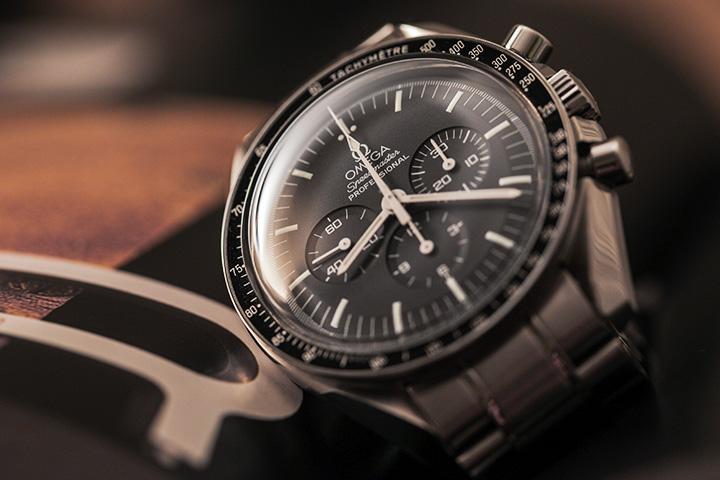
In any discussion of the world's most legendary and iconic timepiece, you won't get far without mentioning the Omega Speedmaster Moonwatch. While you might know several luxury watches that are fantastic divers and can fly across continents, how many do you think travelled to the Moon? That's the Omega Speedmaster Moonwatch for you.
Born in 1957, Moonwatch was a massive release, and the history of moon landings is a big part of the Omega Speedmaster's appeal. Over the years, the brand has offered a huge variety of Speedmaster models, all integrated with a nice design, workhorse movement and chronograph function used in space missions.
There's a common saying, 'If anything isn't broken, don't fix it'. And no one has stood by this advice more closely than the Omega Speedmaster. However, to cater to the modern taste and necessities, Omega revamped the iconic Moonwatch in 2021 to release the new generation Omega Speedmaster Moonwatch Professional Ref. 310.30.42.50.01.002.
When updating an existing brilliant model, the approach has to be very careful, and we're glad Omega did excellent work in this sense. The Luxury Hut recently had the opportunity to grab this steel Moonwatch with sapphire crystal replacing the previous hesalite crystal, and we're completely in love with it!
Collectors with an eye for the classic Speedmaster Moonwatch aesthetic can rest assured—the new sapphire Speedmaster delivers everything you'd hope for and more. But, before reviewing this new iconic Omega model, we'll share some basic information on the watch that was actually worn on the surface of the Moon!
Even if it's your 1001st time hearing this, we bet you wouldn't mind!
History: The Journey to the Moon
1957 was one of the most crucial years in the history of Omega, as the brand launched a slew of models that went on to become icons as a part of their 'Professional' collection. The Swiss watchmaker introduced a trio of sport-focused tool watches, each featuring 'Master' in its name, with the 'Speedmaster' being the most influential of the three.
But the interesting fact is the Speedmaster wasn't designed to go to the Moon. It was originally designed for racing cars, drivers, or anyone interested in measuring elapsed times with 1/5th of a second accuracy.
The first Omega Speedmaster Ref. CK2915 came in a 39mm case with an engraved tachymeter on the bezel and featured a three-register chronograph. The Speedmaster was the first of its kind to feature a tachymeter scale on the external bezel and was created as a response to a mandate for a robust, precise, and waterproof watch that was legible, reliable, and easy to manipulate. Since then, the tachymeter scale has been wildly adopted by other chronograph pieces.

The original Speedmaster stood apart from the new Moonwatch version in more than one way—thanks to its vintage Omega logo, featuring an oval-shaped 'O' and distinctive 'Broad Arrow' hands.
This first-generation Speedmaster had a brief run for two years before being replaced by the Ref. 2998. While the Omega 2998 retained the same dial configuration and hand-wound Calibre 321 movement, it introduced an aluminium bezel insert instead of the plain steel bezel. Additionally, the 'Broad Arrow' hands were replaced with alpha-style hands. Today, pencil-style hands are used on most Speedmaster models.
Five years later, in 1962, when astronaut Wally Schirra wore his personal Omega 2998 on a nine-hour, six-orbit mission aboard the Sigma 7, the Speedmaster began its long and fruitful relationship with NASA.
No other watch on Earth can rival the Speedmaster when it comes to space exploration – the only watch worn on the Moon.
How did the Omega Speedmaster become the 'Moonwatch'?
On September 21st, 1964, Director Deke Slayton of Flight Crew Operations issued an internal memo that the Apollo and Gemini flight crews required a highly accurate and durable chronograph. The astronauts approached Slayton with a request, stating they needed a watch suitable for both training and flight.
The memo landed on NASA engineer James Ragan's desk. Ragan then drafted a request for quotation and sent it to 10 different watchmakers, including Rolex, Omega, Longines, and Lucien Piccard. Only four responded: Rolex, Hamilton, Omega, and Longines.
NASA's test process
For a long time, there was this rumour circulating that NASA purchased the Omega Speedmaster from a jewellery store in Houston, and thus, it became their watch of choice for space. But this is NASA we're talking about, and the first thing we know is that it has strict guidelines, procedures, rules and standards for astronauts.
For the watches to qualify for in-flight use by the astronauts, NASA designed a set of tests, like:
- High-temperature test
- Low-temperature test
- Humidity test
- Vacuum test
- Shock-resistance test
- Corrosion test
- Low-pressure test
- High-pressure test
- Acceleration test
- Vibration test
- Sound test

NASA's strict qualification standards allowed each watch a maximum deviation of six seconds per day during normal use after testing.
There are no brownie points for guessing who successfully completed all the tests. It's the OMEGA Speedmaster. While we shouldn't say it aloud, Rolex Ref. 6238 failed the humidity test, and the movement simply came to a stop.
The tests were completed on March 1st, 1965, and on March 23rd, 1965, astronauts John Young and Virgil Grissom wore the Omega Speedmaster Ref. 105.003 on the Gemini 3 Mission.
Finally, humankind made history on July 21st, 1969, when Apollo 11 astronauts Neil Armstrong and Buzz Aldrin stepped on the lunar surface. While it may have been Neil Armstrong who took the first giant leap for humankind, Buzz Aldrin took the giant leap for Omega. Tied to his spacesuit with a Velcro strap was the Speedmaster Reference ST 105.012, which became the first watch ever worn on the Moon.
Since then, the Speedmaster has served the most lunar missions and is rightfully termed the 'MOONWATCH'.
Key design features of the 'First Watch on the Moon'
- 42mm, Asymmetrical, Stainless steel case
- Black dial printed with the word 'Professional' & featuring baton hands & luminous tritium
- Hesalite glass
Since then, the watch has seen various iterations over the decades, including the Omega Speedmaster Professional, which remains one of the most popular and enduring models today.
Modern Omega Speedmaster Professional Moonwatch
The Speedmaster is undoubtedly Omega's most important collection, and the Moonwatch is its crown jewel. So, it's needless to say that Omega would need to treat it very carefully when the time came to bring an update to one of its most treasured models.
The best part is that to fulfil the task without betraying the loyal fans of Speedy, Omega did what any reputed brand should: 'They listened to their fans.' And, born, was the "Omega Speedmaster Professional Moonwatch Ref. 310.30.42.50.01.002" in 2021.
The key differences between the original Speedmaster and the modern version are seen in:
- The glass protecting the dial (hesalite vs. sapphire)
- The bracelet (all brushed vs. brushed/polished)
- The case back (solid vs. transparent).
In addition to that, there is an updated Master Chronometer-certified engine, a new style bracelet and plenty of changes in the dial, bezel and crystal. Most importantly, you get all this without forsaking the Speedmaster's most important detail – it still remains flight-qualified by NASA!
Of course, good looks alone have never made watch legends.

What's special about this watch?
Few models in the world of luxury watches are unquestionably icons, and the Omega Speedmaster is one of them. Imagine a watch worn by NASA astronauts on the Moon, not once but on several occasions. The Omega Speedmaster Moonwatch has pushed the limits of physical endurance and human courage and is the longest-produced in Omega's catalogue.
When you see the new Omega Speedmaster Moonwatch Professional 310.30.42.50.01.002 at a glance, everything appears similar and identical, but basically, everything has changed! While we were only hoping for Omega to update the previous Calibre 1861 with the far more modern Calibre 3861, it decided to change some other parts of the watch as well, like the case crown, bezel, pushers, dial, hands, bracelet, and the clasp. Are there too many changes?
But we don't complain because, even with so many changes, the watch still looks like a Moonwatch. Thanks to Omega, the brand has really paid attention to the details, ensuring the 'new' Speedmaster still looks like the original.
So, what has Omega done?
Well, it has given its best-seller model a nice vintage touch to make it look closer to the early Professional model. For vintage watch enthusiasts, the Omega Speedmaster Professional Moonwatch Ref. 310.30.42.50.01.002 is an absolute must-have.
It is characterised by an applied 'Omega' logo instead of a printed one on the dial, a box sapphire crystal, and an exhibition sapphire case back. As this watch has Sapphire crystal on both the front and back, it is commonly referred to as the 'Sapphire Sandwich'.
Additionally, the dial of this new sapphire version is a bit darker and has a clearer snailed finishing on the sub-dials than the previous iteration.
However, the first thing that gets your attention is the steel bracelet, which has a nostalgic look and feel. The bracelet attached to this latest generation Moonwatch has polished surfaces, and the fit is highly impressive.
The 'New' Omega Speedmaster Moonwatch has raised the bar on all fronts, improving precision, finishing, and reliability. But the good thing is that the Speedmaster Moonwatch is still competitively priced, considering its 'icon' status and overall quality.
Read More: What is special about the Omega Speedmaster Moonwatch?
Our Initial Review
As we already know, the Omega Speedmaster Moonwatch Professional is one of the most established watches in the market. It showcases the perfect blend of historical significance, timeless design, and luxury.
Let's start with the case. The 42mm case respects the signature Speedmaster Moonwatch ST 105.012 design and endorses a Professional asymmetrical case design with twisted lugs, protective shoulders for the pushers and crown, and a mix of brushed surfaces. There's nothing new in that, really. But it surely is slightly shorter and thinner.
With the watch incorporating the new Calibre 3861, you could have expected a thicker size, but this new Moonwatch Professional version appears to be thinner than the past model. This significantly changes the perception of how the watch sits on the wrist, which, in our opinion, is excellent and, in fact, better than it was.
One of the major updates is to be seen on the bezel. While we expected a black polished ceramic insert with a white enamel scale, Omega retained the classic black anodised aluminium insert. Honestly, we think Omega did a good job by embracing the existing style, as ceramic often appears too glossy for such a tool watch.
On the other hand, aluminium is great-looking and also respectful of the original Professional model. The font on the bezel tachymeter scale is sharper, crispier, and thinner than the previous model. If you look closely at the bezel, you can find the 'Dot over 90', aka 'DON,' which will definitely please seasoned collectors.
Another very attractive change is seen on the bracelet, comprising small and smaller links, and the taper is extreme. Tapering from 20mm to 15mm to the clasp is a considerable narrowing, and we love how the bracelet sits around the wrist. It gives off a nice vintage feel and appears more like a dress bracelet than the previous model. Rest assured, it easily slides under the cuff.

Other notable updates include a slimmer, polished bevel, a wider brushed band, and slightly more angled lug tips. Moreover, the crown is wider, which helps to wind the watch.
For the new generation, Omega still offers the choice of Hesalite and Sapphire sandwich models. Having worn both, we prefer the Sapphire version for its brushed bracelet with polished interlinks and an applied, diamond-polished logo on its dial. That's not all! The sapphire case back gives you a stunning view of the new co-axial movement inside.
Speaking of the movement, while it looks quite similar to the previous 1861 movement, it isn't. The new Calibre 3861 uses a Co-Axial movement, a system that Omega has been using for over a decade. But this is the first Speedmaster Professional to use this.
However, there's one thing we'd like to point out. The bridge work in this new Moonwatch is not as detailed as it used to be. This slightly makes the movement lacking aesthetically, but it's definitely much better when it comes to functionality and practicality. From a technology standpoint, it's hands down a much more impressive movement.
We wore this watch for four days straight, and we really like how the bracelet tapers and comfortably fits on wrists, including smaller wrists, all day, every day. The large dial and this slim-fit bracelet work really well for us.
Lastly, the Omega Speedmaster Moonwatch Professional has remained an icon for decades, and this model undoubtedly earns high praise from The Luxury Hut. It immediately reminds you of the lunar travel and the remarkable accomplishment of science.
REVIEW: Omega Speedmaster Moonwatch 310.30.42.50.01.002
Basics:
- Model: 310.30.42.50.01.002
- Case Size: 42mm
- Material: Stainless Steel
- Dial: Black 'Step' Dial
- Bezel: Anodised Aluminium
- Crystal: Sapphire
- Bracelet: Stainless Steel
- Movement: Calibre 3861
- Power Reserve: 50 hours
- Water-Resistance: 50 metres
Case
In a surprising move, Omega has made the new 3861 Moonwatch thinner than its predecessor, with the new generation sitting at 13.2mm thick. The asymmetrical stainless steel case measures 42mm with 20mm between the lugs and 47.5mm from lug to lug. It has lyre-type twisted lugs, flat-capped chronograph pushers, protective crown guards, and a double-bevel case back.

The case of Ref. 310.30.42.50.01.002 takes inspiration from the fourth generation ST 105.012, famous for being one of the watches worn by Apollo 11 astronauts who landed on the Moon in 1969. It is slightly shorter but looks very appropriate on the wrist. The case is primarily finished with brushed surfaces, accented by a polished bevel along the side. It is brushed horizontally on the case bands, angled inside the lugs with a bevel running from one lug to another and polished accents.
Bezel
The sapphire version has an updated steel bezel with an anodised aluminium ring that has not changed except for three small details—the nostalgic 'Dot over 90' (a nod to pre-1970s Speedmasters), a slightly lighter font, and a dot diagonal to 70. It seems all of this has been made to bring back the flair of the vintage ST 105.012 model.

These small details invariably enhance the appeal. However, the font of the tachymeter, still calibrated to 500 units, appears a bit thinner, crispier and sharper than in the previous references.
Dial
Here, we see a classic matte black 'stepped' dial with a bit of grained texture and some changes. 'Stepped means the sloping towards the edges begins with a small vertical bevel.
One of the most noteworthy inclusions is the applied 'Omega' metal logo, which instantly demarcates the new Speedmatser from its siblings.
The dial is decorated with a central seconds and minute hand that is now slightly domed at the ends to follow the bevel of the Step dial. The central second's hand now has a slightly larger diamond luminous tip positioned closer to the dial's periphery. Omega also now uses a teardrop counterweight with a thinner hand.
The word 'Speedmaster' is enlarged to match the width of the 'Professional'. The three sub-dials are recessed, and the central part has a fine concentric pattern. There is a minute counter at 3 o'clock, an hour counter at 6 o'clock and a running seconds counter at 9 o'clock. And it seems the disc registers are slightly deeper on this new version.

The dial's minute track now has 3 divisions per second, unlike the 5 divisions of the previous model, which is relevant to the 3Hz frequency of the 3861 movement. This allows you to read out most accurately when you stop the chronograph seconds hand.
The hour markers are short, and the indices have a different profile when you look at them on a loop. They seem to be 'crossing over' the step of the dial and extending toward the raised portion. There's a slightly matte portion with white-on-black printing for minimum glare and maximum contrast. Omega ensured the dial didn't look cluttered.
The dial uses a fair amount of Super-LumiNova lume on the central hands and indices for increased readability in low-light conditions. Interestingly, the lume appears lighter in person than in the official images.
Bracelet
The 'Sapphire Sandwich' Moonwatch is presented on a polished-brushed five-arched-links-per-row bracelet. It comprises short cross sections with an oval profile, and all the individual links are fixed by small screws instead of the old pin and tube set-up. Thanks to the screws, the length of the bracelet can be easily adjusted.
The bracelet doesn't have a fully brushed appearance, as the inner links running down the bracelet's centre are polished in a new oval shape. This new steel bracelet design is a great improvement compared to the previous one. It is now more comfortable, better executed and dressier, with a width of 15mm.

This bracelet style endorses profound tapering from 20mm to 15mm to the new clasp design. This tapered design adds to the vintage style of the timepiece.
The best is yet to come. Previously, the end link had a long central piece that extended from the case, increasing the lug-to-lug distance. Now, the end link is shorter than the lugs, and the middle section is more recessed. This change moves the bracelet's articulation further back into the case, improving comfort, especially for smaller wrists.
Another significant aspect is the nostalgically narrow clasp with a Twin-trigger release system and the Omega logo with a striation on the outside. You can also see a little bit of a polished bevel between the sand-finished flange and the sand-finished top. The new Moonwatch benefits from a smaller, thinner, and shorter clasp.
Movement
The watch is powered by Omega's remarkable Co-Axial Calibre 3861, a Master Chronometer certified for its outstanding performance, precision, and resistance to magnetic fields. COSC first approved this manual-winding chronograph movement with Co-Axial escapement before it was tested and approved again by METAs, ensuring the highest standard of precision.
It beats at 21,600vph (3Hz) frequency, offers 50 hours of power reserve, is resistant to at least 15000 gauss of magnetic resistance, and is accurate to 0/+5 seconds per day. It also features a hacking seconds function that stops the second hand whenever you pull the crown out, which is useful for setting the time accurately.

To accomplish the magnetism, the balance spring is made of silicon, and to help get the tiny adjustments right, the balance is free-sprung and adjusted with small weights that look like screws on the balance wheel. There are rhodium-plated bridges with Côtes de Genève finishing.
Other Details
- Case Back- As said, almost everything has been updated, and the case back is no different. Turn to see the brilliant mechanism through the sapphire case back of the Omega Speedmaster Moonwatch 310.30.42.50.01.002. It lets you appreciate the beautiful Calibre 3861 movement and mentions 'THE FIRST WATCH WORN ON THE MOON'.
- Crystal—This Moonwatch features virtually scratch-resistant sapphire crystal glass on the front and case back. The crystal on the back showcases the Calibre 3861's functioning inside.
- Lugs—The lugs tilt inward but also bevel outward. On the outside, there is a polished, longitudinal sheer section that expands at the end of the lugs and thins out of the Mid-case.
- Price & Availability
The Omega Speedmaster Moonwatch reference 310.30.42.50.01.002 with sapphire crystal is a great buy at £7500.
The watch's demand and popularity are based on its rich space heritage and design aesthetics, which further contribute to its appeal.
While vintage models from the 1960s and 1970s are coveted, even the latest Moonwatch models, including the 310.30.42.50.01.002, are increasingly popular among connoisseurs due to their space lineage and appealing aesthetics.
The model 310.30.42.50.01.002 has proven to hold value, making it a reliable option for investment among beginners and seasoned collectors. However, due to its increased popularity, it can be challenging to find one in retail. You can shop the model at a slightly higher price from the pre-owned market.
The Omega Speedmaster Moonwatch reference 310.30.42.50.01.002 is a current production model as of November 2024.
Who is this watch for?
The Omega Speedmaster Moonwatch Ref. 310.30.42.50.01.002 is built for versatility and durability, making it suitable for anyone who plans to wear it in their daily lives. Its design blends modern sophistication with timeless aesthetics, making it suitable for almost everyone. Plus, the title 'First Watch To and On The Moon' makes the Omega Speedmaster fascinating to space enthusiasts.
While best known for its connection to space, the Speedmaster Moonwatch, with its sturdy power reserve of almost two days and 50 metres of water resistance, is a great choice for those who love outdoor activities while wearing a stylish piece.
In short, the new Omega Speedmaster Moonwatch 310.30.42.50.01.002 is for anyone who appreciates history, craftsmanship and quality, from space lovers and watch collectors to professionals and adventurers alike
Final words
To conclude, the Omega Speedmaster Moonwatch 310.30.42.50.01.002 is a horological gem that will remain relevant for years to come as not just a watch but a symbol of innovation and precision.
Consistency is definitely not a bad trait, and the purpose-built aesthetic of the Speedmaster is the watch's most celebrated characteristic. Omega has done a brilliant job retaining the Moonwatch's core elements while incorporating the necessary upgrades that previously failed to make sense. Collectors may now breathe a collective sigh of relief, as this is the worthy successor they wanted!